Pickering Seeks Resident Input on New Traffic Calming Guidelines
The City of Pickering has launched a public survey and mapping tool to gather resident feedback on traffic and road safety concerns. The input will help shape new Neighbourhood Traffic Calming Measures Guidelines. Residents are encouraged to share their experiences with speeding and unsafe intersections in their neighbourhoods.
Link to survey – CLICK THE IMAGE BELOW and scroll down when there:
__________________
[Cameras…they do the job, they generate revenue by lawbreakers, they’re practical, they’re relatively inexpensive….BIGGEST TAKEAWAY: They work.]
The Case for Speed Cameras: What the Data Shows
For years, automated speed enforcement cameras were one of the more contested tools in Ontario’s road-safety toolkit — cheered by parents and safety advocates, dismissed by critics as a “cash grab.” The debate came to a head in November 2025, when the Ford government’s Bill 56 banned the devices across the province. But the data collected before and since that ban tells a consistent story: where cameras were installed, speeding and speed-related collisions fell sharply, and where they have since been removed, both have started climbing back.
How the Cameras Worked
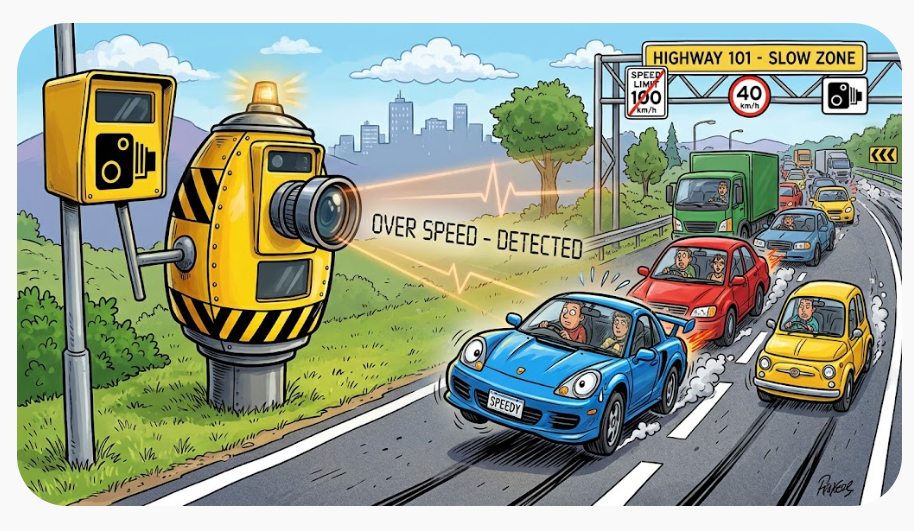
Automated speed enforcement (ASE) cameras use radar to clock a vehicle’s speed and photograph its licence plate if it exceeds the limit by a set threshold, typically issuing a mailed fine with no demerit points attached. Ontario municipalities deployed them mainly in school zones and community safety zones, rotating a limited number of units through dozens of locations to maximize coverage.
Toronto: The Largest Dataset
Toronto ran the province’s biggest program, and its results are the most thoroughly studied. A peer-reviewed evaluation covering 250 school zones from January 2020 to December 2022 — led by Dr. Andrew Howard and published with support from SickKids — found that automated enforcement cut the proportion of speeding vehicles by 45 per cent citywide. The reductions were consistent across zone types: in 30 km/h zones, the share of drivers speeding fell from 60 per cent to 43 per cent; in 40 km/h zones, from 51 per cent to 30 per cent; in 50 km/h zones, from 58 per cent to 36 per cent. Average operating speeds dropped by as much as 7 km/h, and the 85th-percentile speed — the benchmark traffic engineers use to judge how fast most drivers actually travel — fell by 10.7 km/h.
Most dangerous drivers
The most dramatic effect was on the most dangerous driving: the number of vehicles travelling 20 km/h or more over the limit dropped by 87 to 88 per cent. Dr. Howard’s team noted that speed is “the single most important factor in pedestrian injury risk,” which is why the school-zone focus mattered — a pedestrian struck at 50 km/h is roughly five times more likely to die than one struck at 30 km/h.
Guelph, Hamilton, and Waterloo Region
Guelph’s program, one of the more granular case studies, showed average speeds near its camera sites falling from 42 km/h to 33 km/h — a 21 per cent drop. At Taylor Evans Public School, compliance with the posted 30 km/h limit jumped from just 7 per cent of drivers before cameras went in to 52 per cent afterward. The city ran eight cameras on a rotating basis and had planned to expand coverage to every elementary school zone before the provincial ban intervened.
Cash grab is nonsense
Hamilton offered an unusual but telling piece of evidence: ticket revenue from its cameras fell 57 per cent between January and August 2025 compared with the same period the year before — from $1.3 million down to $559,000. Mayor Andrea Horwath pointed to the drop as proof the cameras were changing driver behaviour rather than functioning as a “cash grab,” since fewer speeders meant fewer tickets, not more. Hamilton had approved doubling its fleet from four to eight cameras just weeks before the province’s ban took effect, and the city’s broader Vision Zero push had already coincided with a 34 per cent drop in injury and fatal collisions since 2019.
Waterloo Region’s council cited similarly strong results heading into 2025, when the program was projected to bring in $9.8 million in fines even as compliance improved — regional staff and councillors argued the revenue trend reflected a shrinking pool of repeat offenders, not a permanent cash cow. The region had been planning to add cameras to more school zones that fall. After the ban forced a shutdown, decommissioning the program cost the region more than $780,000.
What Happened After the Ban
Premier Doug Ford called the cameras a “cash grab” and moved to eliminate them province-wide effective November 14, 2025, backing the decision with $210 million for alternative measures — speed bumps, raised crosswalks, roundabouts, signage, and additional police enforcement, with $42 million released immediately and $10 million earmarked for Toronto. Toronto Mayor Olivia Chow noted that camera revenue had helped fund more than 900 crossing guards and 18 police officers, and questioned how those positions would now be paid for. University of Toronto infrastructure researcher Matti Siemiatycki was blunt in his assessment: “Speed cameras really make the roads safer,” reducing both collisions and fatalities.
The effects of Ford’s traffic camera ban
The aftermath has largely borne that traffic cameras work. A Toronto staff report released in June 2026 found the number of drivers travelling at least 16 km/h over the limit in former camera zones had surged by nearly 400 per cent since the cameras came down, prompting Mayor Chow to formally call for their reinstatement. Ottawa’s own tracking of former camera sites showed a similar rebound in speeding once enforcement stopped. In other words, the behaviour change documented in Toronto, Guelph, Hamilton, and Waterloo Region wasn’t a coincidence of the moment — it reversed almost immediately once the cameras went dark.
The Public Wanted Them to Stay
Public opinion never really turned against the cameras, even amid the political fight. A CAA survey found 73 per cent of Ontarians supported speed cameras in targeted zones like school areas, and Ontario’s police chiefs publicly backed keeping the program in place even as the province moved to scrap it. Parent groups in Hamilton organized specifically to push back against the ban, and municipal leaders across the GTA and Waterloo Region lobbied the province to reconsider.
The international research base points the same direction. A long-running UK study tracking roughly 2,500 camera sites in England, Scotland, and Wales from 1992 to 2016 found nearby collisions fell by 17 to 39 per cent and fatalities by 58 to 68 per cent within 500 metres of a camera — researchers estimated that adding 1,000 more cameras to Britain’s roads could save up to 190 lives a year.
The Bottom Line
Whatever one thinks of the politics around ticket revenue, the safety data from Ontario’s own municipalities is remarkably consistent: automated speed enforcement measurably slowed drivers down, cut the number of extreme speeders by roughly half to nearly nine-tenths depending on the zone, and did so specifically in the school and community zones where children and pedestrians are most at risk. Since the provincial ban took effect, the early evidence — a near-quadrupling of extreme speeding in Toronto’s former camera zones, a similar rebound in Ottawa — suggests that whatever gap the province’s $210-million alternative package is meant to fill, it hasn’t yet replaced what the cameras were doing. For municipalities like Pickering weighing their own traffic-calming options, the record built by Toronto, Guelph, Hamilton, and Waterloo Region over the past several years offers a clear, evidence-based starting point for that conversation.
Sources: City of Toronto Automated Speed Enforcement Program Evaluation; SickKids/Dr. Andrew Howard study (Toronto school zones); CBC News (Guelph, Hamilton, Waterloo Region, Ontario ban coverage); CP24; CTV News Toronto; London School of Economics speed camera study.