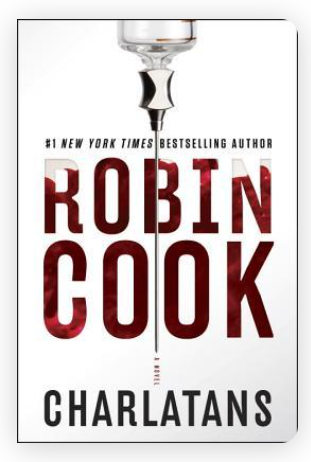
 CHARLATANS, Robin Cook
Synopsis
Noah Rothauser is the new super chief resident at Boston Memorial Hospital. Housing state-of-the-art medical facilities, it’s always been Noah’s dream to work for such an esteemed institution. But the pressures of the role become all too clear when a seemingly routine operation results in the tragic death of an otherwise healthy man. With potential malpractice suspected it falls to the newly appointed surgical doctor to investigate what happened.
Questioning those involved uncovers bitter feuds within the hospital’s surgical staff when Dr. William Mason, the egotistical, world-class surgeon who performed the operation, is quick to blame staff anaeshtetist Dr. Ava London for the disastrous outcome. However Dr. London, along with the nursing staff, point the finger at the surgeon.
When two more anaesthesia-related deaths occur, Noah is forced to look closer at the impressively competent, charming, yet mysterious Dr. London, and he quickly realizes there’s far more to her than meets the eye. With his own job and integrity coming into jeopardy, Noah must decide which doctor is at fault and who he can believe – before any more lives are lost . . .”
Richard says
Robin Cook hits the mark for much of this book. The plot line of a young resident surgeon, Noah Rothauser, in his daily work at a Boston Hospital reads really well. Some readers may find the extensive use of medical terms and medical jargon a bit off putting but nevertheless, the story line is really well developed and very engaging.
The romance between the two protagonists of the book, surgeon Noah and anestheistist Ava London, builds with grow intensity but a nagging drawback. As the romance grows and the suspense intensifies, readers will be hard pressed not to sympathize with Rothauser as the more intense, more naive partner in it. His romantic intensity grows while Ava’s seems somehow more controlled.
As more story pieces fall into place, the plot thickens. The death toll from operating room mishaps mounts and finger pointing includes Rothauser’s love interest, Ava. Cook pulls the reader more deeply into the story with Rothauser’s growing curiousity as to the causes of the surgical casualties, especially when a senior surgeon jabs Rothauser as being the ultimate cause of the deaths.
Can Ava London, the love interest, be blamed? Is she authentic? Is she hiding something? Rothauser begins to dig deeper. The story gets more suspenseful.
The suspense is relentless until the closing chapters. There it bogs down into too much detail and too abundant verbosity. Yet, for the most part, the book is absolutely captivating and suspenseful. A very enjoyable read right to its conclusion. An 8/10.
___________
Robin Cook has an interesting commentary at the end of the book, a criticism of today’s medical profession in general as being tediously slow in producing medical practitioners and lax in authenticating the validity of many medical professionals today. Read what he says….
AUTHOR’S NOTE
The profession of medicine has always had a problem with charlatans, and there have been quite a number of infamous cases in which the perpetrators literally “got away with murder” after assuming the identity of a real doctor who had either died or moved to another state. Now that the world is engulfed in the digital age, the situation is getting worse and accelerating because of the vulnerability of databases, which make it possible to augment curriculum vitae or even create them completely de novo. Such hacking activities trump the old-fashioned need for identity theft. Compounding the problem is the easy availability of specialized professional knowledge on the Internet, as well as the training potential of virtual reality programs combined with modern simulation systems composed of remarkably realistic, computer-driven mannequins that precisely mimic human pathophysiology and response to treatment. The consequence is that the difference between the physician and the motivated non-physician in terms of apparent basic knowledge and know-how will progressively narrow, effectively blurring the line between the real doctor and the fake.
The origin of the term “charlatan” comes from sixteenth-century French, and it initially referred to a medical quack, although its meaning expanded to include all imposters. Today the word is garnering new significance and meaning. With social media exploding around the world (currently the number of people using Facebook alone is approaching two billion) and the fact that it is estimated that more than 75 percent of the people using Facebook lie to “airbrush reality,” there are a lot of new charlatans of varying degree. In a very real sense, being an imposter on some level is rapidly becoming the norm. Indeed, it is generally estimated that 5 to 10 percent of Facebook’s almost two billion accounts are “sockpuppets” or fake, online charlatan profiles. Others believe the percentage is significantly higher. Of course, such a situation is hardly surprising considering the attraction. Psychologists think of social media as a virtual-playground for a culture that is becoming progressively narcissistic. The inherent lack of the usual social restrictions of face-to-face interactions creates a dissociative anonymity devoid of any meaningful reprisal, while offering the potential of unlimited and continual egotistical affirmation and gratification. People can be whoever they want to be and say whatever they want to say for whatever reason with both harmless and not-so-harmless consequences even to themselves. It is a “brave new world,” and it is evolving rapidly.
Members of the medical profession are no exception in the use of social media, including Facebook, Twitter, Instagram, Snapchat, various dating sites, and other sites. They too fall prey to its allure and pitfalls. Surveys have shown that more than 90 percent of physicians are using it for personal reasons and a lesser percentage for business purposes. This personal use has not been without consequence. More than 90 percent of State Medical Boards have received complaints of inappropriate online behavior by physicians while using social media, and there have been episodes of disciplinary action.
Like society in general, the medical profession is in a state of rapid change due to digitization and associated technologies. No longer is it the major source of medical information for the public since that role has been co-opted by the Internet. A few years from now the entire paradigm of the practice of medicine will change from hospital-centric sick-care that began in the nineteenth century to patient-centric personalized preventive-care built around continuous real-time monitoring and treatment algorithms, and it will take place mostly in the home, workplace, and ambulatory care centers, not in pricey and dangerous hospitals. In response to this tectonic shift due partially to the pressure of runaway costs of healthcare, medical education will have to be dramatically altered to remain relevant, especially since it is one of the most conservative professional pedagogies. The current expensive, long drawn-out, overly competitive path of four years of college, four years of medical school, and up to seven years of hospital-based residency, all of which was instituted in 1910 and hasn’t changed much since, will have to be drastically updated. The novel Charlatans presages the need for such a change. And on a lighter note, the novel also begs the question: Did your doctor truly get the training he or she so ostentatiously advertises with all those easily reproduced diplomas hanging on the office wall?