
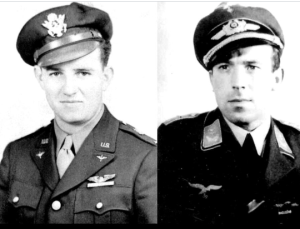
Charles Brown Franz Stigler
Twenty thousand feet above Germany, Charles Brown was bleeding out in his pilot’s seat.
His B-17 bomber looked like someone had taken a sledgehammer to it. Bullet holes punched through the wings. Half his crew dead or unconscious. The tail gunner hung limp in his turret, blood frozen to the metal around him.
Charles squinted through his cracked goggles. His bomber lurched and shuddered with every gust of wind. One engine was smoking. Another had quit completely.
They weren’t going to make it home.
That’s when the German fighter appeared off his wing.
Franz Stigler pulled his Messerschmitt close enough to see inside the American cockpit. This should have been the easiest kill of his career. The bomber was defenseless. Dying. One burst from his guns and it would be over.
But when Franz peered into that shattered cockpit, something made him freeze.
The tail gunner wasn’t moving at all. The waist gunners had stopped firing. These weren’t warriors anymore.
They were just scared kids trying not to die.
Franz had twenty-seven kills to his name. He was three away from earning Germany’s highest honor. This bomber could have been number twenty-eight.
But his flight instructor’s words echoed in his head: “If I ever see you shoot at a man in a parachute, I’ll shoot you myself.”
These Americans were as helpless as men in parachutes.
Franz made a choice that could have gotten him executed.
Instead of opening fire, he flew alongside the crippled bomber. He waved at Charles through the cockpit glass. Not to taunt him. To signal him.
Charles thought he was hallucinating. German pilots didn’t wave at Americans. They killed them.
But Franz stayed right there, wingtip to wingtip. When other German fighters approached, Franz waved them off. Mile after mile, he escorted the dying bomber toward Allied territory.
Charles and his crew watched in stunned silence as their enemy became their guardian angel.
When they reached the North Sea, Franz pulled close one last time. He looked directly at Charles and gave him a crisp salute. One pilot honoring another. Then he banked away and disappeared into the German sky.
Charles landed in England with his surviving crew, alive because a stranger had chosen mercy over duty.
For forty years, the moment haunted him.
Who was that German pilot? Why did he save us? Charles wrote letters to veteran groups. He called military historians. He asked every former airman he met.
Nobody had ever heard of a German fighter escorting an American bomber to safety.
Most people thought he’d dreamed it up.
But Charles never stopped searching. He had to find the man who’d saved his life.
In 1990, a researcher finally gave him a phone number in Canada. Franz Stigler.
Charles dialed with shaking fingers.
“Hello?” came the voice with a slight German accent.
“I think you saved my life in 1943,” Charles said. “You were flying a German fighter. I was in a B-17 that should never have made it home.”
Silence stretched across the phone line.
Then, barely a whisper: “You were the pilot. The bomber with the dead tail gunner.”
Franz had never forgotten either.
They met in person six weeks later. Two old men, grandfathers now, embracing like brothers at the airport.
Franz had carried the secret for forty-seven years. In Nazi Germany, showing mercy to the enemy was treason. He could have been shot for what he’d done.
“I saw your tail gunner,” Franz told Charles over coffee. “He was just hanging there. And your waist gunners – they were boys. Just boys trying to get home.”
Franz couldn’t bring himself to fire on defenseless children.
The two men became inseparable friends. They traveled together, speaking at schools and air shows. Showing the world that even in war’s darkest hour, people can choose humanity.
Charles would introduce Franz as “the man who saved my life.”
Franz would smile and say, “We were all just boys trying to get home.”
Charles died in 2008. Franz followed eight months later, as if he couldn’t bear to live without the friend he’d saved all those years ago.
Their story tears my heart apart and puts it back together again.
Franz didn’t have to show mercy. He was surrounded by people telling him Americans were monsters. He had every reason to pull that trigger and earn his medal.
But he looked past the uniform and saw the human being underneath.
He saw frightened kids who just wanted to see their families again. The same thing he wanted.
Imagine if more people made Franz’s choice. If we looked beyond the labels and saw the person inside. If we chose compassion when the world demands cruelty.
Next time someone tries to convince you that another group of people deserves your hatred, remember Franz Stigler flying beside that broken bomber.
Remember that mercy is always a choice.
Even when everything around you screams for revenge.