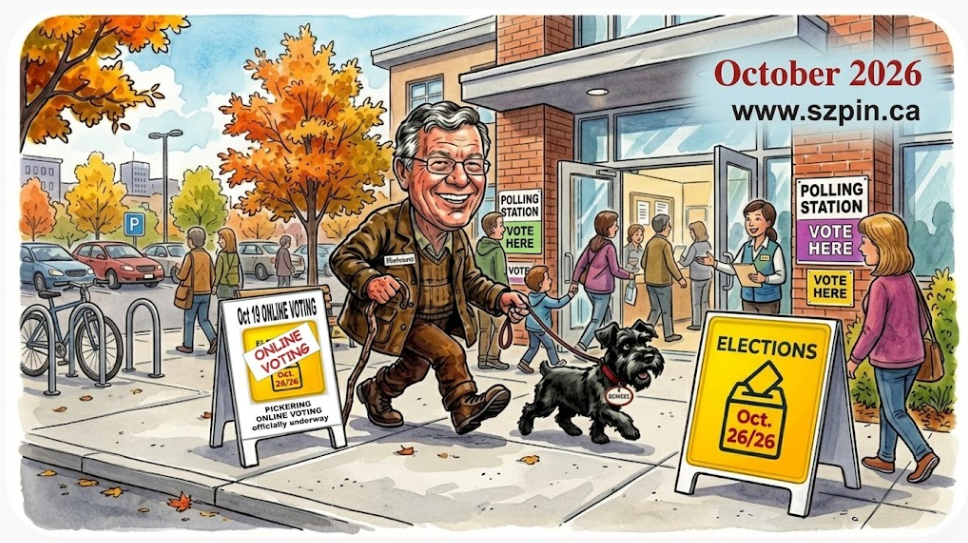
Shaun Rickard was unable to attend the Mayor Panel disccuion of Oct. 20/26. However he has responses to all the posed questions of the debate.
October 23, 2026
Every Question from the Mayoral Debate, Answered
I couldn’t attend the October 20 mayoral debate, so I promised residents I’d answer every question. The organizers never sent them, so I watched the full recording and wrote them down myself. Here is that promise, kept.
Since the October 20 mayoral debate, residents have been emailing me, sending me direct messages and commenting online, asking where I stand on the questions asked that night. I promised each of them I would answer every question publicly, in writing. This is that promise, kept.
I missed the October 20 mayoral debate at the Pickering Event Centre. The invitation arrived only days before, when my schedule was already committed. I’ve owned that, and I promised residents I would answer every question asked that night, publicly and in writing.
After the debate, I asked the organizers in writing to send me the full list of questions, including the audience questions. I never received a response. I also asked the organizers why two of the seven certified candidates for Mayor, Zargham Rasool and Andrea Wood, were not invited to take part. That question has never been answered either. Every candidate on the ballot met the same requirements to run, and residents deserve to hear from all of them.
So I didn’t wait. I watched the full public recording of the debate, all two hours of it, and painstakingly wrote down every question myself, as it was asked. Below, you’ll find each question, lightly edited for readability, followed by my answer. Questions that were put to the whole panel, to the non-incumbent candidates and from the community are all here.
Read them, compare them with what the other candidates said, and decide for yourself.
Opening
Every topic from the October 20 debate.My answers at a glance.
Q1: What are the three biggest problems in Pickering that need solving right now?
A: First, affordability. Our total property tax bill went up more than 9% in just two years, 5.35% in 2025 and 3.81% in 2026, nearly double inflation, while food bank visits across Durham passed 300,000. Residents can’t keep absorbing that.
Second, growth that’s outrunning our infrastructure. Towers and subdivisions are being approved before the roads, sewers, schools and emergency services are in place to support them, and existing taxpayers are left covering the gap.
Third, trust in City Hall. Council meetings went fully online in January 2025, residents’ time at the microphone has been cut, and basic information is being refused through freedom of information requests. Residents have been shut out of their own City Hall, and that has to change on day one.
Development and Growth
Q2: Every candidate says that they support responsible growth. What does that mean in practice, and what development would you say no to?
A: In practice, responsible growth means the studies come first, the infrastructure comes first and growth pays for growth.
I would say no to approvals that come before the environmental, traffic and fiscal studies are finished. That’s what happened in Northeast Pickering, where about 1,600 hectares of farmland were approved before the studies were done. I’d pause implementation of that plan until those assessments are complete, public and independently verified.
I’d also say no to projects that bypass density limits in established neighbourhoods. On Liverpool Road, Council approved 51 townhouses in 2024, and the developer now wants 81 on a dead-end road, backed by a traffic study based on a single September weekday. And I’d say no to housing on our waterfront. New density belongs along the Highway 401 corridor, where the transit and roads can support it.
Q3: When infrastructure cannot adequately support a proposed development, would you support delaying or reducing it? And what would you need to see before allowing it to proceed?
A: Yes, absolutely. If the infrastructure isn’t there, the development waits or gets smaller. Before I’d support it going ahead, I’d want to see confirmed water and wastewater capacity, an independent traffic study based on real, current counts, an emergency access plan, and school and fire service capacity. Those are especially important for anything near the nuclear station.
The City can use holding provisions, so an approval can’t be acted on until the infrastructure is actually in place. And growth has to pay for growth. Existing taxpayers shouldn’t be covering the cost of servicing new developments.
Q4: Even if Council says no, the Ontario Land Tribunal can overturn Council’s decision. How do you deal with the OLT?
A: You deal with the OLT by making decisions that can stand up there. The City loses at the Tribunal when its decisions are based on opinion instead of evidence. My approach is to make sure Council’s position is backed by independent studies on traffic, servicing, emergency access and the environment, so if a developer appeals, the City has a solid case.
I’d also have the City work with residents and community groups early, so their evidence is part of the record. And I’ll push the Province, through the Mayor’s seat at Durham Regional Council and our MPPs, to give municipalities and residents a fairer say in the process. Giving up before the fight isn’t an option.
Q5: How realistic do you see the other candidates’ plans, and why is yours superior?
A: I’ll let residents judge the other candidates’ plans. Everyone who put their name on the ballot deserves credit for that.
What I can say about mine is that it’s in writing, it’s detailed and every section shows where the numbers come from. Much of it is built on freedom of information requests I filed myself, on the City’s own reports and on years of working with residents on issues like the towers at Frenchman’s Bay, which we fought and won. My commitments are things a Mayor can actually deliver: capping the City’s share of the property tax, a forensic audit in the first 100 days, growth that pays for growth, and reopening City Hall to residents. I take no developer donations, so I answer only to the people who live here.
Q6: For those suggesting either limiting development or stopping the construction of homes, and talking about affordable housing, do you have a concern about the impact on supply if you cut supply?
A: I’m not against building homes. Pickering needs them, especially homes young families and seniors can actually afford. My concern is building the wrong things in the wrong places, without the infrastructure to support them.
Approvals aren’t the same as homes. Developers are already sitting on approvals for towers that aren’t being built because the market isn’t there. Approving more of them doesn’t create affordable housing. What does help is directing density to the right places, like the Highway 401 corridor, building a real mix of townhomes and missing-middle housing, and making sure the City has a clear definition of affordable housing and targets it can be held to.
Property Taxes and Finances
Q7: What commitment are you making on property taxes, and what specific budget decisions would allow you to keep that commitment?
A: My commitment is a cap on the City’s portion of your property tax, starting with my first budget, a 0% increase on the City’s share. The City sets about 30% of your total bill, and that’s the part I’ll control. I’ll also push for restraint at Durham Region.
To keep that commitment, I’ll commission an independent forensic audit of City finances, spending, developer agreements, casino revenue and legal costs in my first 100 days, so we find savings before asking residents for another dollar. I’ll end the practice of taxpayers funding developer infrastructure. I’ll publish plain-language budgets so residents can see every dollar. And I’ll stop the spending on Council conflict, from legal fees to investigations, that has cost taxpayers money for four years.
Q8: To those of you who are at zero now, tell us, is that realistic?
A: Yes, on the City’s share, if you’re willing to make real choices. I’m being upfront that my 0% applies to the City’s portion of your bill, about 30%. I can’t promise what Durham Region or the Province charge, and I won’t pretend I can.
A zero increase on the City’s share is realistic when you find the waste first, stop subsidizing developer infrastructure, collect the revenue the City is already owed, and prioritize spending on what residents actually need. That’s exactly why the forensic audit comes in the first 100 days. Families have had to make those choices with their own budgets for the last two years. City Hall can too.
Q9: We have these infrastructure needs. Residents know they’re real, and the city needs them. How do we manage that when it comes to the finances, especially for those who are talking about a 0% increase?
A: By making sure the right people pay for it. Much of the infrastructure strain in Pickering comes from new development, and new development should pay for its share through development charges, community benefit charges and servicing agreements. Existing taxpayers shouldn’t be covering those costs.
We also need to stretch every dollar further: fix and maintain what we already own before building new, get projects done right the first time, and go after every provincial and federal infrastructure dollar available. And we need to make our assets pay their way. My Blue Economy plan for Frenchman’s Bay, for example, is designed to fund itself through docking and fuel fees, not taxes.
Q10: Does growth leave existing residents better off financially, and what would you need to see in the numbers to be confident that it does?
A: Right now, too often it doesn’t. Residents were told for decades that growth pays for growth, and many of them have watched their taxes climb while their roads get more congested.
To be confident growth leaves residents better off, I’d want to see the full lifetime cost of each new development, including roads, pipes, parks, fire and policing, set against the development charges and taxes it will bring in, done independently and published. I’d also want to see the City’s long-term debt and debt payments clearly, and the balance between residential and commercial taxes improving. Right now homeowners carry most of the load. More jobs and more commercial investment in Pickering are what really change that equation.
Q11: How do you stop building the things that the city will require in the future? Most people would like to see some further investment in the city. How do you do that?
A: I don’t want to stop investing in our city. Residents deserve good recreation centres, libraries and community spaces. The question is timing and how we pay for it.
Build in phases, as the population and the tax base that will use the facility actually arrive, instead of taking on large debt years ahead of time. Make sure developers in growing areas contribute their fair share. Use naming rights and partnerships, but at fair value and in the open. And maintain the facilities we already have properly, so we’re not paying to replace them early. Investment in the city is good. Debt that residents weren’t asked about isn’t.
Q12: Would you support the privatization of some of these recreation centres?
A: No. Public facilities should stay publicly owned. Residents paid for them, and they should be run for residents.
I do support partnerships and naming rights that bring in money, as long as they’re done in the open and at fair value. I filed a freedom of information request on the City’s $1-million, 15-year naming rights deal with Dorsay, and I published what I found. Deals like that should be public before they’re signed, not after.
Transportation
Q13: What is the single most important transportation improvement Pickering needs, and what would you do as Mayor to get it delivered?
A: Getting people across Pickering, north to south, reliably. Too many neighbourhoods, like Bay Ridges, are a long walk from a bus stop and a long ride from the GO station, groceries and banks. The new rapid bus line on Highway 2 will only work if people north and south of it can actually reach it.
Transit in Pickering is run by Durham Region, so as Mayor I’ll use my seat on Regional Council to push for frequent north-south connections to Highway 2, the GO station and the rapid bus line, and better on-demand service for seniors and people with mobility challenges. And I’ll make sure new development isn’t approved until the roads and transit to support it are in place.
Q14: Can Pickering accommodate substantial growth while remaining as dependent on cars as it is today?
A: Not if growth keeps going where the roads can’t handle it. Most residents depend on their cars, and that isn’t going to change overnight, especially for seniors and families. So we need to stop approving density on roads that are already at capacity, like Liverpool Road south of Bayly.
At the same time, we have to make transit a real option for people who need it or want it: students, seniors, people who can’t afford a car. That means reliable, frequent service and putting new density where transit actually exists, like the Highway 401 corridor and the GO station area, not on dead-end roads.
Q15: Do you support the Bus Rapid Transit project on Kingston Road?
A: Yes, I support it. Faster, more reliable transit across Durham is good for Pickering. But a rapid bus line is only useful if residents can actually get to it.
Right now, many Pickering neighbourhoods are a long walk from a bus stop, and local routes don’t line up well with each other. If residents can’t easily reach the rapid bus line on local Durham Region Transit, or if the schedules don’t connect, it won’t help them. So as Mayor, I’ll push at Regional Council for frequent local routes that feed into the rapid bus stations from north and south, with schedules coordinated so people aren’t left waiting to make a connection. Residents and businesses along Kingston Road also need a real say in how access, left turns and construction are handled. And the people who actually ride transit should be consulted on the routes, not just the planners.
Trust, Transparency and Leadership
Q16: What would you change about how City Hall makes decisions so that residents can see their input has an impact?
A: On day one, I’ll reopen Council chambers to residents, in person, at every meeting. I’ll double residents’ time at the microphone from five minutes to ten, and bring back real question-and-answer sessions with residents, on the record.
I’ll require public consultation before major planning decisions are approved, not after. I’ll replace long, hard-to-read financial reports with plain-language budgets. And when Council makes a decision, residents should be able to see what they said, what staff recommended and why Council decided what it did. Freedom of information requests shouldn’t be the only way residents get answers.
Q17: What responsibility does the Mayor have for the tone of Council, and what would you personally do when a disagreement becomes hostile?
A: The Mayor has more responsibility for the tone of Council than anyone. The chair sets the standard, and residents have watched meetings end in shouting, cleared chambers and recesses. That’s a failure of leadership.
When a disagreement becomes hostile, I’d call a short break, cool it down and deal with it privately and respectfully, not on social media or through taxpayer-funded complaints. I’d meet with every member of Council early in the term, set clear expectations for how we treat each other, and apply the rules equally to everyone. Council members can disagree strongly on the issues and still respect each other. Residents deserve that.
Q18: As someone outside of Council, tell us your thoughts on what the problem has been, and what would you do immediately to change the dynamic?
A: From the outside, the problem has been a Council more focused on fighting each other than on serving residents, and residents paying for it, in legal costs, in investigations, and by being shut out of their own chambers.
The first thing I’d do is reopen the chambers to the public, because people behave better when residents are in the room. I’d sit down one-on-one with every member of Council in my first two weeks, wipe the slate clean, and agree on how we’ll conduct ourselves. And I’d make sure the cost of Council conflict is included in the forensic audit, so residents see what it’s cost them and it doesn’t happen again.
Q19: Condo towers in Pickering have been questioned, but there are now double-digit approvals in place. Are those towers coming, or not?
A: Some will be built and some may not, depending on the market. But an approval is an approval. If the market turns, a developer can build what’s been approved, and the City needs to plan for that now, not hope it doesn’t happen.
That means making sure the roads, water, sewers, schools and fire service can handle the towers that have already been approved, before approving more. And where approvals are being changed or reworked, residents should be told and consulted, not find out after the fact.
Q20: Some say you lack experience. Why not run for Councillor first? Why jump into the role of Mayor right off the top?
A: Because the problems at City Hall start at the top, and so does fixing them.
I’m not new to Pickering’s issues. I’ve lived here for 29 years and run a business in this city for 15, managing budgets with my own money on the line. I led residents in the fight against the towers at Frenchman’s Bay, and we won. I started a petition signed by more than 2,400 residents to hold the City to its promise of a public boat launch. And I’ve spent years filing freedom of information requests and putting the City’s own records in front of residents. I’ve been doing the work of holding City Hall to account for years. Now I’m asking for the job of fixing it.
Q21: If many of the same people are re-elected to Council, how do you expect to govern? Do you think you’d be an effective Mayor?
A: Yes. I’m not part of the conflicts of the last four years, so I can walk in without that baggage, and I intend to use that.
In my first two weeks, I’d sit down one-on-one with every member of Council, over coffee, not across a Council table. I’d ask each of them what they want to accomplish for their ward, where they think things went wrong and what they need from the Mayor. Most residents want the same things: lower taxes, responsible growth, a protected waterfront and an open City Hall. There’s more common ground on Council than the last four years would suggest.
From there, I’d bring Council together early in the term to agree on shared priorities and on how we’ll conduct ourselves, in writing, applied equally to everyone. When disagreements happen, and they will, I’d deal with them directly and privately first, with mediation if needed, not through taxpayer-funded complaints or social media. I’d treat every Councillor with respect whether they agree with me or not, and I’d expect the same in return. And I’d make decisions in the open, so residents can see who is working for them.
Q22: Give us some differentiating factors between yourself and the other campaigns.
A: I take zero developer donations. My campaign is funded by myself, friends and neighbours.
My plan is in writing, in detail, and much of it is built on records I obtained myself through freedom of information requests, including Council conduct costs, Elexicon, Frenchman’s Bay and the City’s naming rights deals. I’ve already done the work of putting City records in front of residents, often when the City didn’t want them released.
And I’ve delivered for residents before, in the fight against the towers at Frenchman’s Bay. I’m not part of the conflict at City Hall, and I’m not a career politician.
Q23: If elected as Mayor, would you also accept the Regional Chair position if offered, and continue in both positions?
A: No. Being Mayor of Pickering is a full-time job, and our residents deserve a Mayor who’s focused entirely on them. As Mayor, I’ll sit on Durham Regional Council and fight for Pickering there. But I wouldn’t try to hold both jobs.
Community Questions
Q24: What is your opinion on the use of AI as a community leader, and would you approve a data centre being built in Pickering?
A: AI is a tool, and a useful one. I use it in my own campaign, the same way many residents and businesses now do: to help research issues, organize large documents like City budgets, staff reports and freedom of information records, and draft and proof my writing. It saves time, and that matters when you’re running a campaign largely on your own. But it doesn’t make my decisions, and it doesn’t speak for me. I check the facts, I decide what I stand for, and I take responsibility for every word that goes out under my name.
For the City, AI could make services faster and easier to use: answering routine questions, helping residents find information, translating documents and reducing paperwork. But Pickering needs a clear, public AI policy first. Residents’ personal information must be protected, residents should always be told when they’re dealing with AI, and decisions that affect people, from permits to by-law matters, must always be made by people who can be held accountable.
On data centres: not without a full, public review. They use enormous amounts of power and water, and as others on stage pointed out, they create very few local jobs once they’re built. They can also bring noise and environmental impacts. Pickering needs employment lands that bring good, lasting jobs to residents. Any data centre proposal would need independent studies, full public consultation and no confidentiality agreements that keep residents in the dark. Residents should know exactly what’s proposed, by whom and where, before Council decides.
Q25: Are you concerned that a three-way progressive and moderate vote split will allow a Robinson victory? How do you plan to address strategic voting with residents?
A: I’d ask residents not to vote out of fear. There’s been no public polling in this race, so nobody actually knows who’s ahead, and telling people their vote will be wasted is a tactic, not a fact.
My message is simple: read every candidate’s plan and vote for the one you believe will best represent you. A vote is only wasted when it goes to someone you don’t believe in. With seven candidates, every vote counts more, not less.
Q26: There has been a rising homelessness issue in Pickering, and with it drug use, crime and danger in the community. Last year people were living in tents in a park, a fire got out of control, and needles have been found where children play. What is your view on how to best deal with this issue before people get hurt?
A: Nobody should be living in a tent in a Pickering park, and no child should be finding needles where they play. We need a real strategy, not just good intentions, and it has to solve both problems together.
The data matters. Across Durham Region, about 1,345 people were counted as homeless in the most recent count, more than double the 2021 number. About half report substance use, and over half report mental health conditions. But the leading reported cause of losing housing is income loss, not addiction.
On housing and outreach, I’ll push to fast-track supportive and transitional housing across Durham, fully fund the 24-hour street outreach team so every person is connected to a real housing plan, press the Region to use available federal encampment funding, and turn seasonal warming centres into year-round, low-barrier spaces.
On addiction and mental health, we need more detox beds and treatment capacity, because demand for voluntary treatment already exceeds supply, alongside harm reduction and mental health outreach. For repeat offenders whose addiction is driving a cycle of crime, I’d study involuntary treatment carefully, following Ontario’s current review, while weighing the real concerns health experts raise about effectiveness and Charter rights.
On keeping parks and public buildings safe, I’d support adjusted hours and secured entry points at libraries, transit stations and community centres, better lighting and sightlines, staff trained to de-escalate, and by-law enforcement paired with outreach on the same call. Local businesses need legal tools too, like trespass notices for specific behaviour, a shared outreach worker and 311 or street outreach as the first call, with police reserved for actual crimes.
Courts have been clear that people can’t simply be pushed from one public property to another with nowhere to go. Enforcement without outreach just moves the problem. The approach that works pairs enforcement with a real place for people to go, and it takes the City, the Region, the Province and the community working together.
Closing Statement
Q27: Closing statement.
A: Pickering, thank you for reading. I wasn’t on that stage, but I wasn’t going to let your questions go unanswered.
For the last four years, you’ve watched Council meetings end in shouting. You’ve watched the chamber cleared and recesses called because Council couldn’t keep order. You’ve watched Council go online for a year and a half, with residents shut out of their own chamber. And you’ve watched your tax bill climb more than 9% in two years, nearly double inflation. Even on that debate stage, the infighting carried on.
Pickering can’t afford four more years of fighting. And you can’t afford four more years of tax hikes that outpace your paycheque.
I’ve lived in Pickering for 29 years. I built a business here, and I’m not a career politician. When two 23-storey towers were planned beside our waterfront, I rallied residents, I dug up the facts, and together, we stopped them.
My plan is simple. Cap the City’s share of your property tax from day one. A full, independent forensic audit in my first 100 days. Growth that pays for growth. Protect our waterfront and green spaces. And reopen City Hall to the people who pay for it. No developer money, just residents.
You deserve a Mayor who does the homework and tells you the truth. Prepared. Respectful. And on your side.